Centrifuge DAO operates as a Corporate Technocracy, a model prioritizing operational efficiency over decentralized resilience.
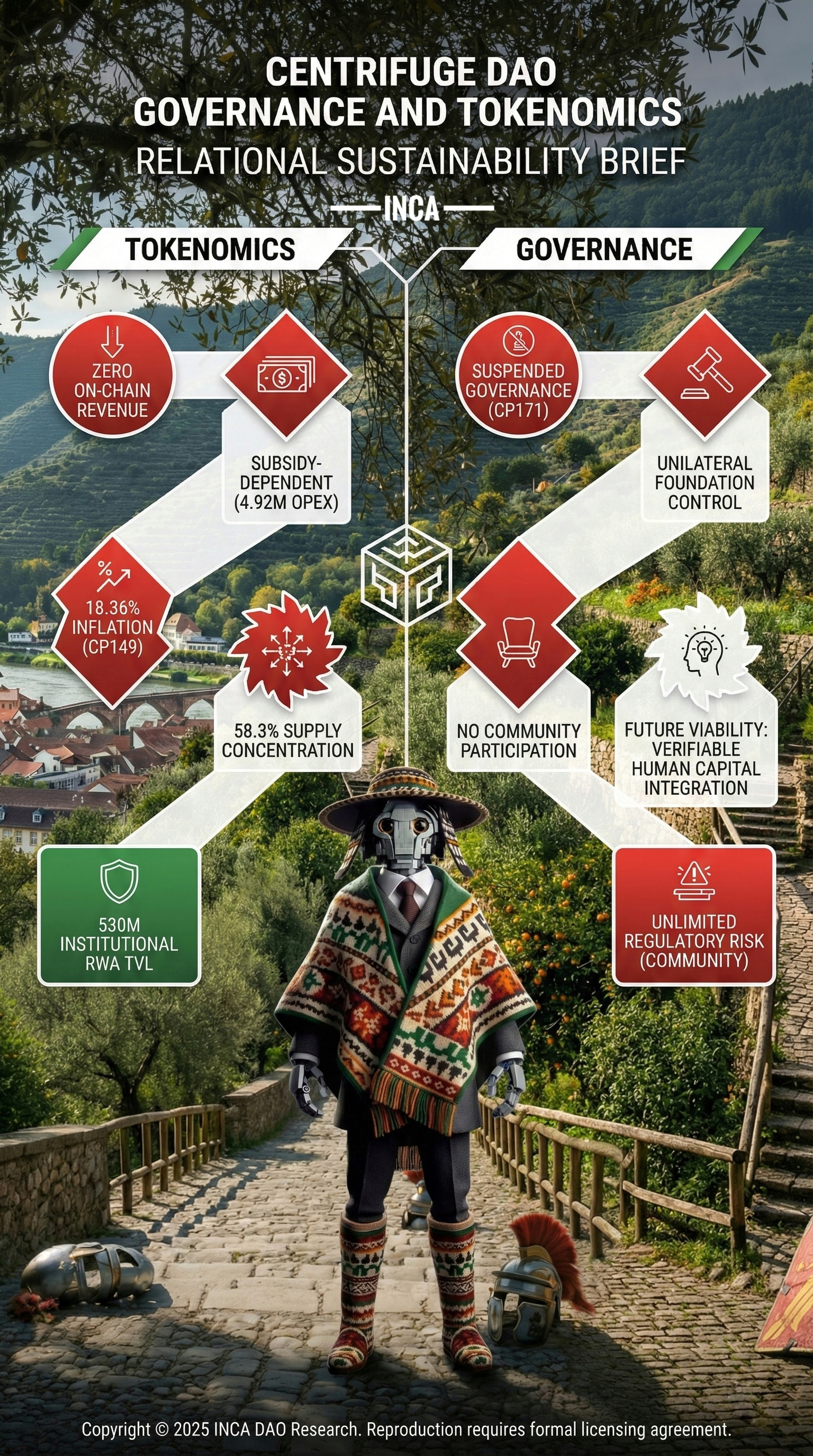
Day-to-day protocol operations and treasury management are controlled unilaterally by the Centrifuge Network Foundation and Centrifuge Labs under suspended onchain governance (CP171), establishing a primary Centralization Vector. Token holder sovereignty is theoretical, contingent on a four million CFG quorum for reinstatement.
Governance Dynamics and Engagement Alignment
The system exhibits extreme Plutocratic Drift, with half of the token supply concentrated among fourteen addresses. The top five addresses alone command approximately one third of voting weight, constituting a latent Structural Veto. This concentration maintain an Apathy Engine, where negligible community participation in recent cycles renders proposal success a form of aristocratic ratification rather than broad consensus.
A critical meritocracy gap exists: the most active governance contributors hold less than one percent of the supply, while institutional whales demonstrate no active participation. This perpetuate governance incapacity, where knowledgeable actors lack verifiable influence or reputational leverage.
Liability and Structural Risk
The Cayman Islands foundation structure provides board indemnity, while community participants bear unlimited regulatory risk without legal protections or claim on offchain collateral. A De Facto Partnership where token holders share downside risk without governance upside.
The protocol also shows Key Person Risk, with technical teams retaining a Sovereign Exception to bypass governance in emergencies. Simultaneous departure of three board members could halt all strategic decisions, treasury movements, and partnership negotiations, indicating moderate technical resilience but severe governance centralization.
Fiscal and Tokenomics Incentives
Financially, the protocol displays fiscal asymmetry and self-subsidized inflation. Annual operational expenditures reach almost 5+ million dollars against unstructured revenue. CP149 minted 100+ million CFG, creating 15+ percent inflation without value accrual mechanisms. Offchain CNF-managed fees generate approximately 2+ million dollars annually from Anemoy products, but these funds are retained rather than burned or redistributed through treasury.
Competitive strength derives from institutional RWA partnerships, generating 500+ million dollars in TVL. However, sustainability requires acknowledging the DAO layer primarily functions as liability buffer, while value creation is centralized. The CFG token’s dual role as a governance right and exit liquidity mechanism creates Structural Dual-Use and Incentive Asymmetry for stakeholders who must choose between farming or voting.
Centrifuge’s fiscal oversight standards are a liability compared with institutional finance competitors. The absence of detailed, published financial statements prevents an audit of total value disbursed through grants (Cost of Agency) against the protocol’s organic revenue recapture.
The Corporate Technocracy Diagnosis
Future viability could align capital providers with labor contributors. Without a permissionless human capital integration to offset structural entrenchment, the system remains rewarding wallet weight over merit, a disenfranchisement placing a Glass Ceiling on long-term qualitative contribution.
Meritocracy is absent; while Plutocracy is latent but non-participating. The protocol competes with TradFi securitization platforms, not onchain models. The community functions as a socialized liability structure that insulates a tokenized fintech startup within a paused DAO.
© INCA DAO Research 2025. Reproduction is reserved for formal licensing engagements.